

59% of Ukrainians trust Zelenskyy, 35% do not - KIIS survey
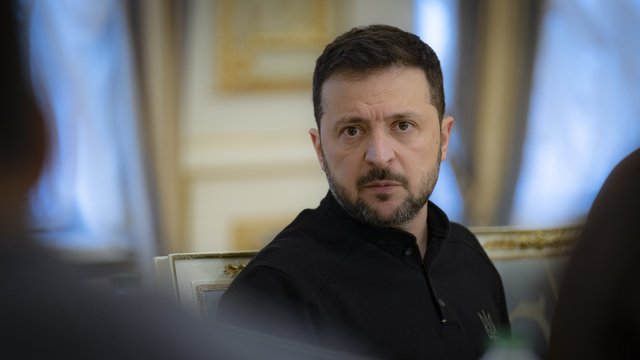
Some 59% of Ukrainians trust the President of Ukraine Volodymyr Zelenskyy, 35% do not trust him, the balance of trust-distrust is +24%, according to the data of a sociological survey conducted by the Kyiv International Institute of Sociology (KIIS) from November 26 to December 29, 2025.
"V. Zelenskyy is trusted by 59% of Ukrainians, 35% do not trust him. The balance of trust-distrust is +24%. In early October, the trust indicators were almost identical, that is, in general, according to the results of December, the level of trust in the president remained unchanged compared to the situation several months ago (in particular, before the appearance of information about corruption in the energy sector)," the KIIS report on the results of the study on Monday on the website.
At the same time, as noted, indicators of trust in the president are very dynamic and context-dependent (especially which agenda dominates public discussions - internal issues, such as public administration, corruption, etc., or external issues, such as relations with partners and peace negotiations). Among respondents surveyed in November (November 26-30), 49% trusted Zelenskyy, and among respondents surveyed in the first half of December (December 1-13), 63%.
However, among respondents surveyed in the second half of December (December 14-29), 55% expressed trust in Zelenskyy. "Therefore, in general, we can see that the president lost about 10 percentage points of trust after the publication of information about corruption in the energy sector, but further, against the background of the international situation (peace negotiations), we see another round of rallying around the flag and increased trust in the president. However, by the end of December, the strength of such rally had weakened somewhat and there was rather a tendency towards a slight but decrease in trust. In any case, by the end of 2025, the level of trust in the president is higher than at the end of 2024 (although during 2025, the peak of support was in early May)," the KIIS report states.
"We can expect that in the future (even right now, taking into account, for example, personnel changes) the indicator of trust in the president will remain dynamic," sociologists note.
KIIS highlights another important aspect of trust in the president – that among 59% of those who trust him, 26% "completely" trust him, and 33% "rather" trust him. The KIIS survey in September-October 2025 showed one of the fundamental differences between these categories. Those who "completely" trust Zelenskyy would like to see him as president after the war. And those who “rather” trust him mostly want to see someone new as the leader of Ukraine (where "new" means someone from the new generation of leaders, not someone from the current opposition).
It should also be noted that among 35% of those who do not trust the President, 23% "completely " do not trust him, and 12% "rathe " do not trust him (and these segments also have different views on individual issues).
From November 26 to December 29, 2025, KIIS conducted its own all-Ukrainian public opinion poll "Omnibus", to which, on its own initiative, it added questions related to trust in President Zelensky, the holding of national elections, the perception of the fight against corruption in Ukraine, and the country’s movement towards democracy. 1,001 respondents were surveyed using the method of telephone interviews (computer-assisted telephone interviews, CATI) based on a random sample of mobile phone numbers (with random generation of phone numbers and subsequent statistical weighting) in all regions of Ukraine (the territory controlled by the Government of Ukraine). The survey was conducted with adult (aged 18 and older) citizens of Ukraine who, at the time of the survey, lived in the territory of Ukraine controlled by the Government of Ukraine. The sample did not include residents of territories temporarily not controlled by the Ukrainian authorities (at the same time, some of the respondents are IDPs who moved from the occupied territories), and the survey was not conducted with citizens who left abroad after February 24, 2022. Formally, under normal circumstances, the statistical error of such a sample (with a probability of 0.95 and taking into account the design effect of 1.3) did not exceed 4.1% for indicators close to 50%, 3.5% for indicators close to 25%, 2.5% for indicators close to 10%, 1.8% for indicators close to 5%.